The BeagleBone Black (BBB) is a $45 credit-card-sized computer that runs
embedded Linux. I recently purchased a BBB along with an $8 4-phase stepper
motor and
driver
to start playing around with slightly “closer-to-the-metal” motion control.
My first objective with the BBB was to simply get the stepper to move, and for
this I started using the included Cloud9 IDE and BoneScript library. After a
while messing around and learning a little JavaScript, along with some help from
my programmer brother Tom, the stepper was moving in one direction using wave
drive logic. However, the code felt awkward. I decided I’d rather use Python,
since I’m a lot more comfortable with it, so I went out in search of Python
packages or modules for working with the BeagleBone’s general purpose I/O (GPIO)
pins. I found two: Alexander Hiam’s
PyBBIO and Adafruit’s
Adafruit_BBIO.
Adafruit_BBIO seemed to be more frequently maintained and better documented, so
I installed it on the BeagleBone per their instructions, which was pretty quick
and painless.
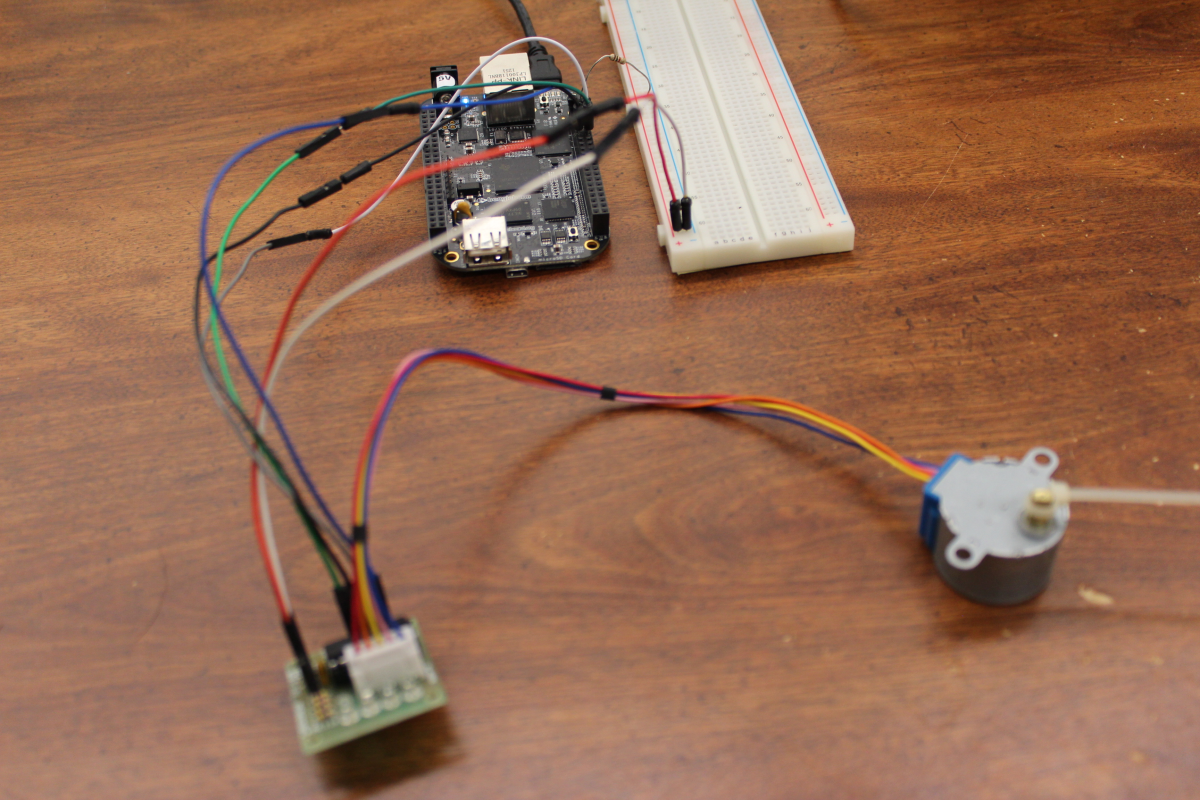
Stepper motor wired up to the BeagleBone Black.
Next, I wrote a small, simple python module,
BBpystepper, with a Stepper
class for creating and working with a stepper control object. Currently the
control uses full-step drive logic, with wave drive available by changing
Stepper.drivemode. I may add half-stepping in the future, but for now
full-stepping gets the job done.
Usage
After installing Adafruit_BBIO and BBpystepper on the BeagleBone, the module can be imported into a Python script or run from a Python interpreter. For example:
>>>frombbpystepperimportStepper>>>mystepper=Stepper()>>>mystepper.rotate(180,10)# Rotates motor 180 degrees at 10 RPM
>>>mystepper.rotate(-180,5)# Rotates motor back 180 degrees at 5 RPM
>>>mystepper.angle0.0
Notes
By default the GPIO pins used are P8_13, P8_14, P8_15, and P8_16. These can be changed by modifying the Stepper.pins list.
By default the Stepper.steps_per_rev parameter is set to 2048 to match my motor (it has a built-in gearbox).
The code doesn’t keep track of where it ends in the sequence of pins. It simply sets all pins low after a move. This means there could be some additional error in the Stepper.angle variable if the amount of steps moved is not divisible by 4.
Final Thoughts
As mentioned previously, half-stepping would be a nice future add-on, along with
a more accurate way of keeping track of the motor shaft angle. Another logical
next step would be to use one of the BBB’s Programmable Real-Time Units (PRUs)
to control the timing more precisely, therefore improving speed accuracy and
allowing synchronization with other processes, e.g. data acquisition. However,
for now this simple method gets the job done.
Having settled in on the Cummins B3.3 for an engine, the next step was to choose
a vehicle to put it in. I had some rough requirements in mind:
Seating capacity: At least 4 people
Air conditioning and decent acoustics/sound system
4-wheel drive
Since the original inspiration for the project was a Cummins B3.3 in a Jeep
Wrangler
(YJ), that
was an obvious candidate, but I also had an affinity for and experience with
Ford body styles and interiors. The decision came down to two potential chassis:
Wrangler vs. Explorer. Both satisfied the basic requirement above, but there
were some more criteria to consider—fitment, noise and comfort, emissions,
initial cost, and fuel economy.
Fitment
An obvious requirement was that the engine fit inside the vehicle’s engine bay.
This contest goes to the Wrangler. The engine bay is huge, and the hood opens
very wide. With the Explorer, a body lift would most likely be necessary.
Winner: Wrangler
Noise/acoustics and overall comfort
The fun and excitement of the Jeep’s removable top comes along with a noisy
ride, and poor acoustics. For me, the Explorer’s acoustics and comfort were
worth the somewhat less hip styling. Electric windows and locks were icing on
the cake.
Winner: Explorer
Initial cost
On the used market, Wranglers fetch about 2–3 times the amount Explorers do.
Spending less on a chassis would save more for the engine, giving the Explorer
the edge.
Winner: Explorer
Emissions
Since this vehicle would likely throw many error codes with an OBD-II computer,
it was important to find a vehicle that was OBD-I. The TJ body style is not
available in the OBD-I years, while the 2nd generation Explorer body style was
just introduced in 1995, barely making the cutoff. The Explorer body style and
interior both beat the YJ, as discussed above, so the Explorer gets the nod
here.
Winner: Explorer
Fuel economy
The most important metric—and the main goal of the project—was to achieve high
fuel efficiency. Thus, this metric would likely decide the contest. Properties
for the two vehicles are tabulated below. On one hand, the Wrangler is lighter
than the Explorer, requiring less energy to get up to speed. However, the
Wrangler is also less aerodynamic, consuming more energy while cruising. To
compare the two, a typical driving scheme was devised, for which rough estimates
for fuel consumption were calculated. This driving scheme included
Accelerating 0–40 mph in 10 seconds
Cruising at 40 mph for 5 miles
Explorer
Wrangler
Mass (kg)
1806 [1]
1331 [2]
Drag coefficient
0.43 [3]
0.55 [3]
Frontal area ($\text{m}^2 $)
2.3
2.3
Calculating fuel consumption during cruising
This was the easy part. Neglecting friction in the tires and drivetrain—which
would be more or less equivalent between both vehicles—energy consumption
during cruising can be estimated by integrating the drag force over the distance
traveled.
Drag force is estimated using the formula
\(F_D = \frac{1}{2}\rho A_f C_D V^2,\)
where $ \rho $ is the density of air, $ A_f $ is the vehicle’s frontal
area (approximately equal for both Explorer and Wrangler), $ C_D $ is the
vehicle’s drag coefficient, and $ V $ is the cruising speed. Since speed is
constant, the integration simplifies to multiplication, giving (in Nm)
\[E_{\mathrm{cruise}} = 3,550,673 C_D.\]
Calculating fuel consumption during acceleration
Calculating the energy required during acceleration included consideration of
both drag and inertial forces. Since drag is not constant during acceleration,
we will use a more general method and integrate the varying power over the
acceleration time, which is simply the force multiplied by velocity, or
Boiling this all down and substituting all but the variables that differ between
the vehicles, we obtain
\[E_{\mathrm{acc}} = 19,787 C_D + 160.2m.\]
The table below summarizes the results for both vehicles. As you can see, these
estimates show the Explorer consuming 16% less energy than the Wrangler, making
it a better choice with regards to fuel economy.
Explorer
Wrangler
Energy consumed during cruising (Nm)
$ 1.53 \times 10^6 $
$ 1.95 \times 10^6 $
Energy consumed during acceleration (Nm)
$ 2.98 \times 10^5 $
$ 2.24 \times 10^5 $
Total energy consumed (Nm)
$ 1.83 \times 10^6 $
$ 2.17 \times 10^6 $
Winner: Explorer
Conclusions
Obviously, since this post is in a series about a diesel Explorer, you can guess
which chassis won out in the end. The Wrangler is a cool design for sure, but
the Explorer’s acoustics, comfort, and most importantly aerodynamics made it my
choice.